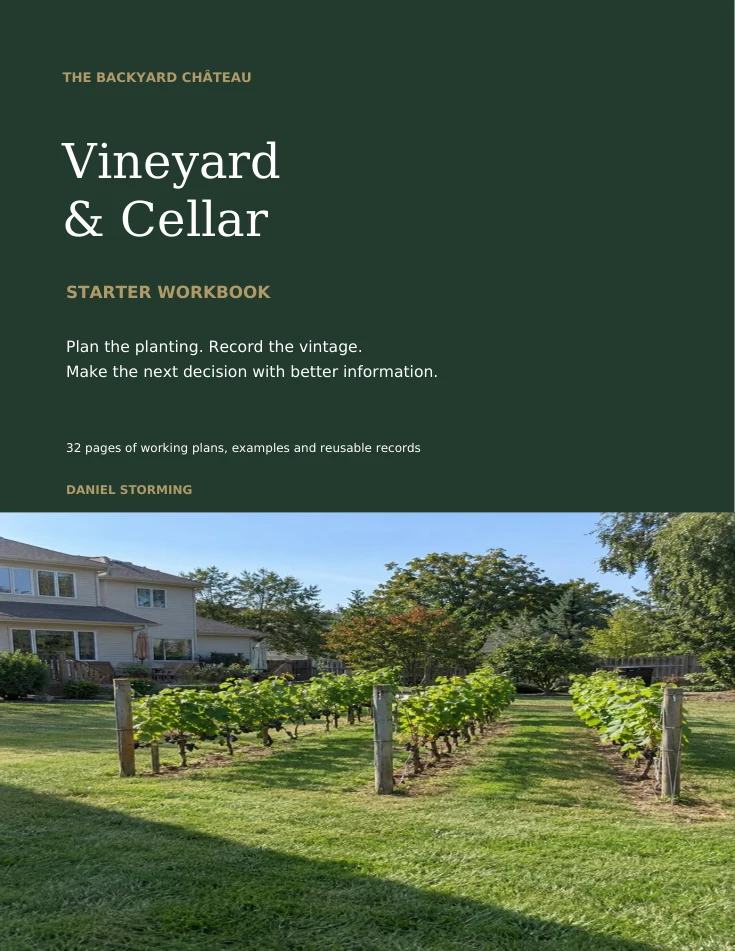
Your backyard. Your first vintage.
How many grapevines
do I need?
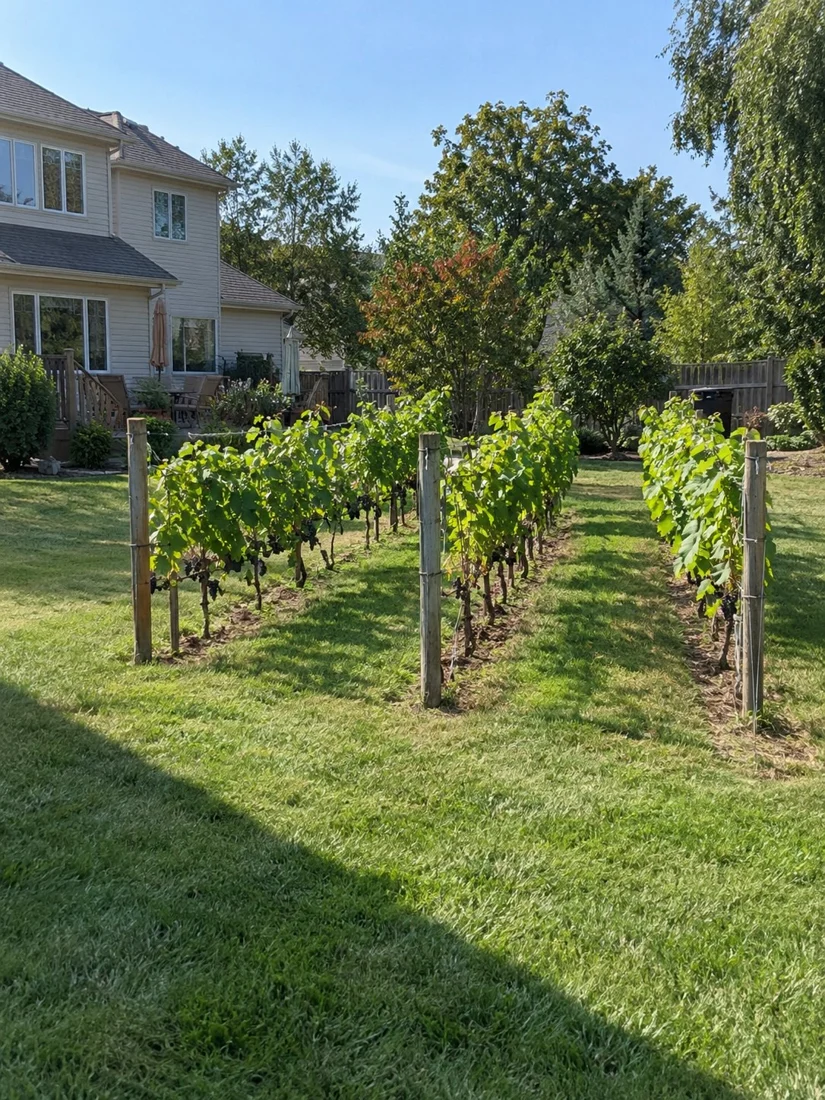
Picture a bottle made from grapes just outside your window. Choose a bottle goal, explore the scale, and take a practical first step toward your own backyard vineyard.
Free calculator · no signup · for an established, cropping vineyard
Your idea, put into numbers
Change the assumptions to explore your plan.
Your inputs stay in this page. A shared link contains only these six numbers. Saving downloads a text file with your assumptions and next steps.
See the calculation and limits ↓The useful question behind the number
A vineyard starts with a place,
then a realistic plan.
A bottle goal gives your idea a scale. It does not tell you whether a particular grape belongs in your yard. Before buying vines, investigate the site, choose locally suitable varieties, and decide how much seasonal work you can take on. A smaller planting that you can care for consistently is a useful place to begin.
How the calculator works
Multiply your bottle goal by the assumed pounds of grapes per finished bottle. Divide that fruit requirement by each end of your mature-vine yield range, rounding each result up to a whole vine. Multiply those vine counts by the two spacing values for a planting-density estimate.
24 bottles × 3 lb of grapes = 72 lb of fruit. At an assumed 5–15 lb per mature vine, that is 5–15 vines. With 6 ft × 8 ft spacing, the density calculation gives 240–720 sq ft, before access allowances. The 24 finished bottles hold 18 liters of wine.
The pre-filled fruit, yield and spacing values are illustrative inputs selected to show the arithmetic. The linked Extension guidance does not validate those example yields for your yard.
Turn the estimate into three decisions
- Check your site. Observe sunlight, drainage and access. Sketch shade, boundaries and working room. Use the backyard vineyard site guide before turning an area estimate into a planting layout.
- Find grapes that belong there. Winter conditions, ripening season, disease pressure and intended wine style all matter. Compare local experience using the hybrid grape selection guide; a hardiness-zone number alone cannot settle the choice.
- Plan the work, then record it. Establish the vines and support system before chasing a bottle count. Use the seasonal care checklist and free vineyard journal to replace guesses with observations over time.
Before your first vintage
Can a few grapevines make enough wine to be worthwhile?
“Worthwhile” can mean learning from a small batch, not filling a cellar. The number of bottles depends on usable fruit, wine style and losses. Try several assumptions above, then compare the result with what nearby growers actually harvest. A calculated vine count is not a promise of that many bottles.
How much space does a backyard vineyard need?
There is no single area that fits every variety and trellis. The calculator treats each vine as occupying a row-spacing by vine-spacing rectangle. Real row layout, shade, paths, setbacks and room to work can change what fits. For a single row, first sketch its length and the working clearance on both sides.
How long until I can make wine from new vines?
Planting starts an establishment process. A small first crop and a mature, repeatable harvest are different milestones. Climate, plant health and training affect timing; ask your regional Extension service when your selected vines should carry fruit. This planner does not predict a harvest year.
Why use a yield range instead of one answer?
One precise number would hide uncertainty. Vines can differ within the same yard, and seasons can differ sharply. The range shows how strongly your plan depends on yield. Even the lower-yield scenario is not a guaranteed minimum; weather, pests or other problems can eliminate a crop.
Can I learn winemaking while my vines get established?
Yes. Sourced wine grapes or juice let you practice cellar organization, measurements and recordkeeping while learning to grow your own fruit. Start with the home winemaking setup guide and keep notes so each batch teaches you something.
Is this planner free? What does the package add?
The planner, guides and calculators are free without an email address. The $19.99 Vineyard & Cellar Starter Package adds the complete digital book, a 32-page workbook and a seven-sheet editable planner. Read the free book sample before choosing.
Make the next step a practical one
From “what if”
to your working plan.
The complete book connects grape growing with home winemaking. The starter package adds a workbook and editable planning sheets to help organize your project.
Digital downloads · one-time purchase · no equipment included